
The Genius and the Algorithm
If Einstein Had AI, Would We Already Live Among the Stars?

Human intuition has a physical limit: processing speed. But what happens when the most abstract mind in history meets infinite computing power? A journey into a 20th century we never experienced.
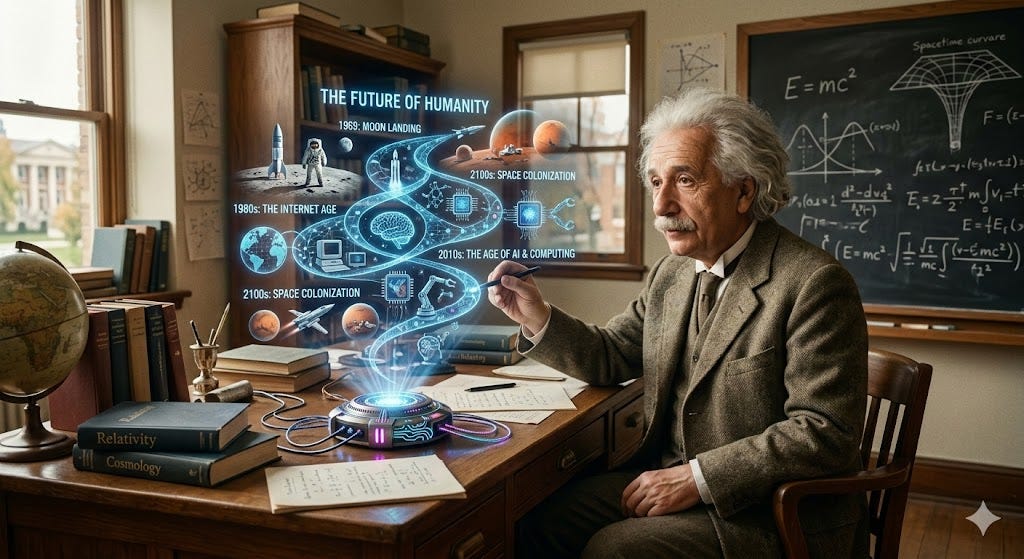
Imagine Albert Einstein in 1945. He is sitting in his study at Princeton, surrounded by sheets of paper scribbled with complex tensors. He is searching for the “Unified Field Theory,” the definitive equation that explains everything—from the infinitely large to the infinitely small. But there is a problem: the mathematics is too dense, the variables are too many, and biological time is running out. Einstein will pass away ten years later, leaving that dream unfulfilled.
Now, let’s change the scenario.
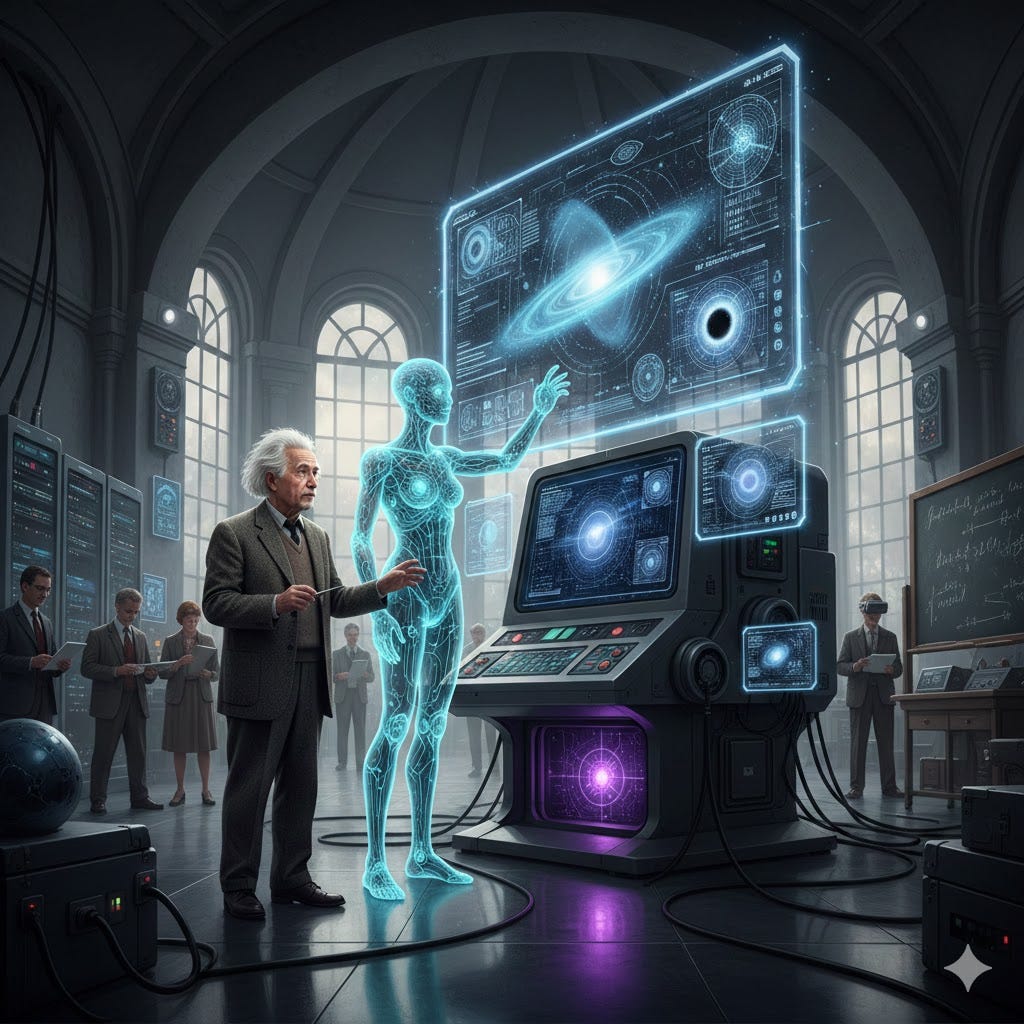
Imagine that on his desk, next to his pipe, there is a terminal connected to a quantum neural network. Not just a calculator, but an Artificial Intelligence trained on non-Euclidean geometry, capable of testing billions of algebraic variants in a single second.
Welcome to the Relativistic Singularity.
1. Collapsing the Wall Between Quantum and Relativity
In our reality, physics is a house divided: General Relativity governs the stars, while Quantum Mechanics governs the atoms. They do not speak to each other.
With AI, Einstein could have utilized Symbolic Regression algorithms to identify the hidden patterns between these two shores. Instead of decades of trial and error, the AI could have suggested the necessary correction to his tensors in just a few hours.
The result? The Theory of Everything published in 1955. Modern physics would not be a frustrating search, but a field solved seventy years ago.
2. Algorithmic Pacifism: A World Without Hiroshima
This is the deepest turning point. Einstein was a pacifist haunted by his involuntary role in the creation of the atomic bomb.
Had he possessed AI-assisted Game Theory models in 1939, he could have mathematically demonstrated to Roosevelt that the nuclear arms race would be a zero-sum game, inevitably leading to Mutually Assured Destruction.
Instead of a letter urging the creation of the bomb, Einstein could have presented a plan for an Energy Defense Shield or a global governance model based on data transparency. In this timeline, 1945 is not the year of the mushroom cloud, but the year of the first clean nuclear fusion plant.
3. “Geometric” Medicine of the 1960s
If the universe is geometry, then life is as well. Einstein saw patterns everywhere. With AI for protein folding, he could have applied his intuitions about the curvature of spacetime to the structure of organic molecules.
1958: Defeat of neurodegenerative diseases through molecular correction.
1965: Average life expectancy exceeds 100 years thanks to predictive medicine.
4. Beyond the Pillars of Hercules: Interstellar Travel
The speed of light limit is Einstein’s dogma. But with AI, he could have explored the mathematical “shortcuts” of Einstein-Rosen bridges (wormholes) with engineering precision.
While we in 1969 watched with awe as a man walked on the Moon, in this Alternate Universe, humanity was already testing the first Warp Drive based on zero-point energy—theorized and stabilized by Einstein’s AI in 1960.
Why Didn’t It Happen?
The tragedy of our history is that genius and tools often never meet. Einstein had the intuition but lacked the computing power; today, we have the computing power, but perhaps we lack that specific type of pure, rebellious intuition.
Today, as we train ever-larger models, we should ask ourselves: Are we just building machines that calculate, or are we finally building the mental telescope that will allow the next Einstein to see the invisible?
What do you think? If we had solved physics in 1955, would we be a wiser humanity or just a more dangerous one?
Leave a comment and share this “What If” with other dreamers.
Did you enjoy this article? Subscribe to the “What if...” newsletter to explore a new variant of reality every week.